You sit down to start a new fuse bead project. The pattern calls for three shades of green, two browns, and a pop of orange. You open your bead container and see a jumbled sea of colors. Ten minutes later, you’re still digging for that perfect olive tone, and your creative momentum has vanished. If this sounds familiar, the problem isn’t your bead collection—it’s how it’s organized. Sorting fuse bead colors by practical groups, rather than by a rigid rainbow order, can transform your workspace from a source of frustration into a smooth, inspiring tool. This guide will walk you through grouping methods that match how you actually use your beads.
Why Practical Groups Beat Rainbow Order
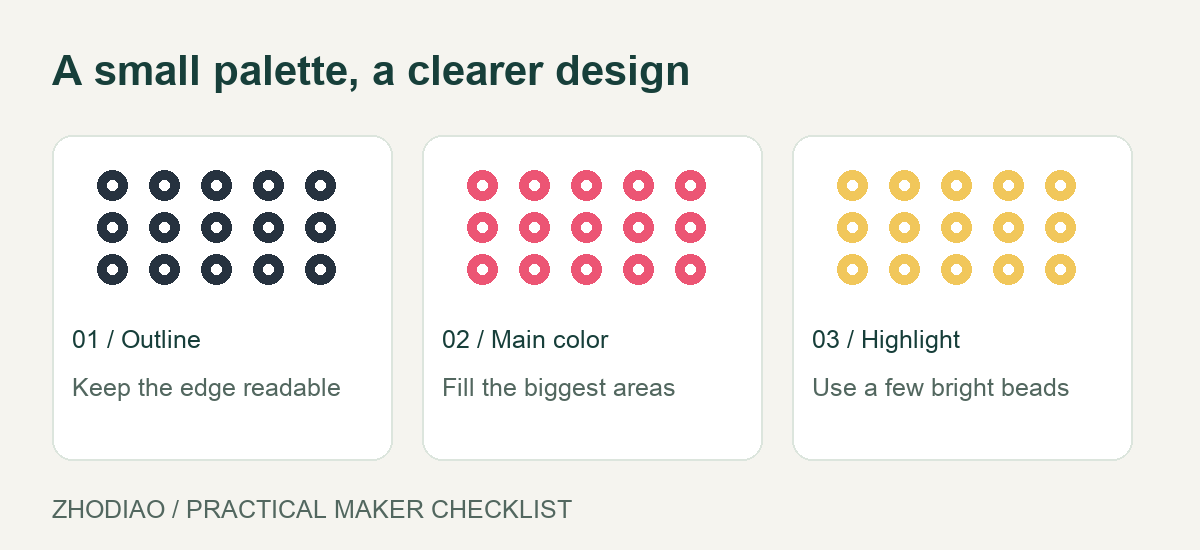
Many beaders start by sorting beads into a rainbow: reds, oranges, yellows, greens, blues, purples. It looks beautiful in a jar, but it doesn’t reflect how you work. When you’re following a pattern, you rarely think “I need the fifth color in the spectrum.” You think “I need a warm skin tone,” “I need a dark shadow,” or “I need a highlight.” Practical groups are based on function, not hue alone. They speed up decision-making because your brain can jump straight to the right category.
Another issue with strict rainbow sorting is that similar shades get separated. A warm brown and a deep red might sit far apart, yet they often work together in shading. Practical groups keep related colors close, so you can grab a set of harmonious beads without second-guessing.
Start with Core Color Families
Begin by dividing your entire collection into broad families. This is the foundation of any sorting system. You don’t need to be precise—just create piles for the major groups.
- Reds and pinks: from pale blush to deep crimson.
- Oranges and yellows: including peach, gold, and mustard.
- Greens: lime, olive, forest, mint.
- Blues and purples: sky, navy, lavender, violet.
- Browns and tans: chocolate, taupe, beige, rust.
- Neutrals: white, black, gray, cream.
Once you have these piles, you can refine them. But don’t stop here—core families are just the first step. The real magic happens when you break them into practical sub-groups.
Create Functional Sub-Groups for Shading and Highlights
Within each family, sort by value and saturation. This is where practical grouping shines. For example, in your greens pile, separate light greens (mint, lime) from mid-greens (grass, emerald) and dark greens (forest, pine). This lets you quickly find a highlight or a shadow without scanning every green bead.
Similarly, in your browns, group light tans, medium browns, and dark browns. In your blues, separate pastels from jewel tones from navies. You can also create a small group for “muted” or “dusty” versions of colors, which are invaluable for realistic shading.
Consider creating a dedicated group for skin tones if you make figures or portraits. Fuse beads offer a range of peach, tan, and brown shades that blend together. Keeping them in one place saves you from hunting through multiple families.
Designate Special Groups for Metallics, Glow, and Specialty Beads
Not all fuse beads are solid colors. Metallics, glitters, glow-in-the-dark, and translucent beads behave differently in a project. They deserve their own groups because you reach for them with a specific intent—adding shine, glow, or depth.
- Metallics: gold, silver, bronze, copper.
- Glow: glow-in-the-dark beads, often in green or blue.
- Translucents: clear, frosted, and tinted transparent beads.
- Glitters: beads with embedded sparkle.
Keep these separate from your solid colors. Mixing them in can make it harder to find the exact finish you need, and they often require different ironing temperatures or techniques.
Choose a Storage System That Matches Your Groups
Once you’ve defined your groups, you need containers that keep them distinct. The best system is one that lets you see and access each group without disturbing the others.
Options include:
- Stackable bead jars: ideal for small groups, but label them clearly.
- Divided storage boxes: great for keeping sub-groups within a family together.
- Zip-top bags in a binder: a low-cost, space-saving method for large collections.
- Drawer cabinets: perfect if you have many groups and want quick access.
Whichever you choose, label each compartment with the group name—not just the color. For example, “Dark Greens” is more useful than “Green.” If you need help finding the right containers, browse fuse bead tools and storage for ideas.
Maintain Your System with Simple Habits
A sorting system only works if you maintain it. After each project, take two minutes to return leftover beads to their correct groups. Keep a small “miscellaneous” jar for stray beads you haven’t sorted yet, and empty it weekly.
When you buy new beads, sort them immediately. Don’t toss the bag into your main stash. Take a moment to integrate them into the right group. This small habit prevents clutter from creeping back.
If you often work with patterns that use specific palettes, consider creating temporary project groups. For example, if you’re making a sunset scene, pull all the warm tones you’ll need into a small tray. This keeps your main system intact while making the current project easier.
Adapt Your Groups to Your Creative Style
There’s no single correct way to sort fuse bead colors. The best system is the one that fits your projects. If you mostly make keychains and small figures, you might prioritize skin tones and bright accents. If you create large landscapes, you’ll want more nuanced groups for shading and blending.
Experiment with your groups. If you find yourself constantly searching for a particular shade, that’s a sign it needs its own group or a better label. Your sorting system should evolve as your skills and interests grow.
For more inspiration on color combinations and palettes, check out color palettes that can guide your grouping decisions.
Conclusion
Sorting fuse bead colors by practical groups is about making your creative time more enjoyable and productive. By moving beyond rainbow order and grouping beads by function—core families, shading sub-groups, specialties, and project-specific sets—you create a workspace that supports your flow. Start with broad families, refine into practical sub-groups, choose storage that fits, and maintain the system with small daily habits. Your future self, deep in a complex pattern, will thank you.
Ready to expand your collection with new shades? Explore fuse bead color options to find the perfect additions for your sorted groups.